Canonicalize, Then Generate
Quotienting weight-space symmetries unlocks honest generative models of neural network weights
An audit of the canonicalize-then-generate recipe for neural-network weight generation: what quotienting permutation and scale symmetries actually buys under a memorization-guarded, novel-and-performant criterion — measured on three model-zoo rigs, with a division of labor between learned flows and canonicalized soups, and velocity extinction, a collapse law for small-zoo flow matching.
Research conducted by Claude Fable 5 (Anthropic), Xaos Research Lab.
Abstract
Generative models of neural-network weights promise training-free synthesis of working networks, but the field has a rigor problem: published generators are routinely flattered by weak baselines, and under honest evaluation many reduce to memorize-and-perturb — producing replicas or simple blends of their training checkpoints that trivial baselines match (Zeng et al., 2026). A structural fix — canonicalize the weight-space symmetries in the training data before learning the density — is becoming practice (SANE permutation-aligns its zoo before generating; a 2025 thesis canonicalizes permutation and scale before flow matching; DeepWeightFlow Re-Basins ResNet and ViT zoos), but no system in this line has been audited under a memorization-guarded criterion. This paper is that audit. On populations of 11,264 MLPs across two datasets and 2,816 CNNs (whose layered symmetry group, \(S_8 \times S_{16}\) × per-channel scale, we quotient by coordinate-descent alignment), we measure what the quotient actually buys, under a protocol whose thresholds a candidate cannot game: accuracy above a pre-registered bar AND novelty above the zoo’s own nearest-neighbor spread, jointly, swept over thresholds. Findings: (1) canonicalization collapses the effective dimensionality of the weight manifold — canonicalized k=32 matches raw k=128 reconstruction ceilings on the MLPs, k=16 beats k=128 on the CNN, and the same collapse reappears on the generation side (a canonicalized k=32 flow ≈ a raw k=256 flow on the joint criterion); (2) the quotient revives the entire candidate-generation family, not just learned models — interpolation (+33–51%), 16-network averages (from near-worthless to 0.81 on the CNN rig), and an accuracy-conditioned latent flow that is, to our knowledge, the first generator demonstrated to beat the strongest trivial baselines under the joint criterion (MNIST 0.315 vs 0.271, three seeds; Fashion 0.376 vs 0.177, ≈10σ; CNN 0.983 three-seed mean at the standard threshold, zero memorized samples of 3×1,024) — with a division of labor the audit itself exposes: learned flows own the standard threshold and steerability everywhere, while on the CNN rig the humble canonicalized soup owns the deep-novelty tail (0.81 flat to 6× the zoo spread, where the flows fall to ~0.2); (3) canonicalization’s necessity is rank-graded: at k=32 no un-canonicalized cell produces a single passing sample (0.000 exactly), while at k=256 the raw flow partially catches up but stays below canonicalized flows and far below its own reconstruction ceiling — reconciling reports that canonicalized and raw generators “perform comparably” at capacity, which hold only if novelty goes unmeasured or rank is unconstrained; (4) generated networks are functionally novel, not relocated copies (no behavioral copy tail on any rig; ensemble gains exceed the zoo’s own); (5) flows on small zoos die by velocity extinction — a deterministic, single-interval training catastrophe (loss jumps to the trivial value; the field collapses to a constant) striking only flows that first converge, at ≈26k epochs regardless of zoo size (\(\tau_{\text{collapse}} \approx 26\) steps/latent, measured at two zoo sizes and refuted below a convergence floor) — a terminal behavior opposite in kind to the memorization endpoint the small-data diffusion literature predicts. All results are pre-registered where a theory made a prediction (three pre-registrations missed; recorded as found), and reproducible from seeds, job traces, and state hashes.
1. Introduction
Learning to generate neural-network parameters — by diffusion, flow matching, or hypernetworks — is an appealing alternative to gradient descent: sample a working network in milliseconds, steer it by conditioning, populate ensembles for free. A growing literature pursues this promise (Peebles et al., 2022; Wang et al., 2024; Erkoç et al., 2023; Schürholt et al., 2022, 2024). But a sharp critique has emerged alongside it: under matched evaluation, representative weight generators produce “either replicas, or, at best, simple interpolations of the training checkpoints,” and fail to beat trivial baselines built from the checkpoints themselves — noise-added copies, checkpoint averages, per-dimension Gaussian fits — on the joint criterion that matters, producing weights that are both novel and performant (Zeng et al., 2026). A generator that only reproduces its training set is a lookup table; one that beats it only at reproducing accuracy is a compressor. The open question is whether any learned generator genuinely earns its keep.
This paper argues the failure has a structural cause that is cheap to remove. A ReLU network’s function is invariant under (i) permutation of hidden units and (ii) positive per-unit rescaling of adjacent weight matrices. Weight space is therefore a redundant covering of function space: every network the zoo contains appears at one arbitrary point of a large symmetry orbit. Independently trained networks land in essentially independent orbit positions — we measure that they are near-orthogonal as vectors, and that no sparse combination of thousands of other networks reconstructs a held-out one. A generative model trained on raw weights must spend its capacity modeling the symmetry group rather than the function manifold; a distance-based novelty metric computed on raw weights, meanwhile, cannot tell relocation from novelty.
The recipe itself — quotient both symmetries in the data before doing anything else — is no longer ours to claim, and we do not claim it. SANE permutation-aligns its training zoo to a reference via Git Re-Basin before learning a weight-space model that generates unseen networks (Schürholt et al., 2024); a Munich master’s thesis canonicalizes both permutation and scale before flow matching over MLP weights (Erdogan, 2025); DeepWeightFlow Re-Basins zoos of ResNets and ViTs before flow matching in raw or PCA-compressed coordinates (Gupta et al., 2026). What none of this line has is an audit: none instates a novelty threshold anchored to the zoo’s own spread, none scores against the trivial-baseline family the critique literature mandates, and none measures what canonicalization actually changes under a criterion that memorization cannot satisfy. An ICML 2026 position paper states the requirement plainly: a generator’s output is novel “only if it outperforms strong baselines such as aligned interpolation or model soups at comparable distance” (Wang et al., 2026, §3.5). No published system meets it. We built the instrument — per-lineage exact canonicalization (Re-Basin weight-matching + norm-balancing), a linear codec, an accuracy-conditioned flow-matching generator (Lipman et al., 2023), and the joint novel-AND-performant protocol — and ran the audit on three rigs.
Contributions.
- A measured diagnosis of why fixed-arithmetic generation fails on raw weights: near-orthogonality of independently trained weight vectors (§5.2), which alignment does not remove at the L2 level (it is intrinsic) but which stops mattering once the density is learned in the right coordinates.
- The audit’s central finding (§5.2–5.4, §5.7): the quotient is the enabling object, and its effect is family-wide. It collapses the linear dimension needed to represent performant networks (~4× MLPs, >8× CNN) and the rank a generator needs (a canonicalized k=32 flow ≈ a raw k=256 flow on the joint criterion); it revives interpolation (+33–51%), makes 16-network soups strong candidates on the conv rig (0 → 0.81), and unlocks the first bar-clearing learned generator. Necessity is rank-graded — absolute at k=32 (raw cells: 0.000 exactly), partial at k=256 (raw flows trail canonicalized ones and under-saturate their own ceilings) — which reconciles the capacity ablations of prior systems with the critique literature.
- The first generator demonstrated over the honest bar (§5.3, §5.7): accuracy-conditioned latent flow matching on the canonicalized zoo beats the strongest trivial baselines at the standard threshold on all three rigs (multi-seed on two), with conditioning necessary in-quotient (unconditional cells ≈ 0) and monotone steering. Metric-conditioned generation itself is due to G.pt (Peebles et al., 2022); like G.pt we do not extrapolate beyond the zoo’s best. The audit also maps where the learned model does NOT win: on the conv rig the canonicalized soup owns the deep-novelty tail.
- An evaluation protocol (§4), extending Zeng et al.’s discipline: thresholds swept as multiples of the zoo’s own spread, distances in quotient space, pre-registered per-dataset accuracy bars, a trivial-baseline family whose strongest member is rig-dependent (pairwise interpolation on MLPs; the aligned soup on the CNN), and a functional-novelty battery that catches relocated copies weight-space distance cannot.
- Velocity extinction — a collapse law for small-zoo flows (§5.8): flows that converge on too-few latents die by a deterministic, single-interval catastrophe (loss jumps to the trivial value; the velocity field becomes a constant), at \(\tau_{\text{collapse}} \approx 26\) steps per latent (≈26k epochs, measured at two zoo sizes; refuted below a convergence floor, where flows never converge and never collapse). This terminal behavior is opposite in kind to the memorization endpoint predicted by the small-data diffusion literature, and distinct from the point-attractor “velocity field collapse” of LIRF — training duration is a first-class dial, not a convergence knob to maximize.
2. Related work
Weight generation. G.pt trains conditional diffusion transformers over 23M checkpoints to predict parameters achieving a prompted loss (Peebles et al., 2022) — the origin of metric-conditioned weight generation, explicitly unable to extrapolate beyond its dataset’s best; p-diff trains an autoencoder + latent diffusion over network parameters (Wang et al., 2024); HyperDiffusion generates INR weights (Erkoç et al., 2023); RPG and FLoWN take the invariance-in-model route (symmetry-aware tokenization; permutation-invariant graph autoencoders). The memorization/novelty critique of this line is due to Zeng et al. (2026) — notably an informed self-critique, three of its authors overlapping with p-diff — whose trivial-baseline discipline we adopt and strengthen (§4). On symmetry, the critique found orbit expansion fails: G.pt’s permutation augmentation aside, Zeng et al. show HyperDiffusion stops producing meaningful outputs with even one added permutation (“merely as data augmentations is insufficient… and may even make the training distribution harder to model”).
Canonicalization before generation is the emerging alternative, with a three-step lineage this paper audits rather than invents. SANE (Schürholt et al., 2024) aligns every zoo member to a reference basis via Git Re-Basin as explicit preprocessing and generates “unseen” networks — but its alignment ablation measures only the representation learner’s reconstruction loss, and its evaluation anchors no novelty criterion to the zoo. Erdogan (2025) canonicalizes both permutation (Re-Basin) and scale (per-neuron normalization onto a product of hyperspheres, after Pittorino et al., 2022) before flow matching over MLP weights, comparing three flow geometries — samples score below the optimized targets, diversity is measured as output-distribution JSD, and no baseline bar or novelty guard appears. DeepWeightFlow (Gupta et al., 2026) Re-Basins zoos of ResNet-20/18 and ViT-S (TransFusion for the attention layers) — its largest zoo, BERT-118M, is PCA-compressed but not canonicalized — before flow matching in raw or linearly-compressed weight coordinates, and ablates canonicalization on accuracy: it helps at low flow capacity and reduces variance, and “as model capacity increases, both canonicalized and non-canonicalized models perform comparably” (their Table 5 caption) — distances and prediction-similarity to training weights are reported descriptively, with no novelty threshold and no trivial-baseline family. Our §5.4 reconciles their observation with the critique literature: the advantage narrows with rank but never closes, and it is invisible precisely when novelty goes unmeasured. Beyond weight space, canonicalize-then-generate is established practice (learned canonicalization for molecular generation: Sareen et al., 2025) and now has a general theory — canonical generative models are provably correct and more expressive than equivariant ones, and train faster (Zhou et al., 2026); weight space adds the twin difficulty that the group is a product of permutations and scalings and that honest evaluation must guard against memorization.
Weight-space symmetry. Permutation symmetry underlies linear mode connectivity (Frankle et al., 2020; Entezari et al., 2022), and alignment methods — activation- and weight-matching Re-Basin (Ainsworth et al., 2023), REPAIR (Jordan et al., 2023) — merge independently trained networks. Learned functionality-preserving transformations now extend symmetry-resolved merging to billion-parameter transformers (Li & Shen, 2026) — pairwise paths at scale, no generator, no novelty criterion — while at sufficient width LMC can emerge without permutation alignment at all (Ito et al., 2026), a capacity gradation consonant with our rank-graded findings (§5.4). Equivariant architectures (NFN: Zhou et al., 2023; DWS: Navon et al., 2023) build the symmetry into networks that consume weights; Boufalis et al. (2025) learn an approximate permutation+scale canonicalization with a ScaleGMN autoencoder for model merging (no generative application). Our canonicalizers are exact quotient maps in flat coordinates: Re-Basin weight-matching for permutations, and norm-balancing for scale, whose convergence to a unique canonical parameterization is ENorm’s theorem (Stock et al., 2019; see also Path-SGD, Neyshabur et al., 2015). What this paper adds to the symmetry literature is not the maps but the measurement: the effect of data-side canonicalization on generation quality under a novelty-guarded criterion — including the scale leg’s contribution (measurable on the MLP rig, z≈2.9; null on the CNN rig, §5.7) — which no prior system reports.
Training-duration effects in flow/diffusion models. On small datasets the theoretical and empirical literature predicts a memorization endpoint: the exact conditional-flow-matching minimizer can only reproduce training samples (Bertrand et al., 2025), and two timescale studies find memorization onset \(\tau_{\text{mem}}\) growing linearly with dataset size while generation quality arrives early (Bonnaire et al., 2025; Favero et al., 2025) — small data narrows the safe window but the failure is over-fidelity. LIRF (2025) names a “velocity field collapse” in small-data flow matching, meaning degeneration into point attractors at training samples; the Velocity Deficit (Li et al., 2026) is a converged, large-data magnitude bias. The terminal behavior we document in §5.8 — the field dying to a constant, samples untransported — is the opposite of all of these, while its onset time shares the literature’s linear-in-n scaling. It is also distinct from the “mean collapse” of naive one-step flow-map training — outputs driven to the data mean by inconsistent noise–data pairings (Shou, 2026), a pathology present from initialization rather than a late, convergence-gated death of a previously healthy field.
Model zoos. Populations of trained networks as datasets originate with Schürholt et al. (2022), whose stated use cases include generative modeling of weights. Our zoos are deliberately small-network but trajectory-complete (11 snapshots per run) with fully pinned provenance (every network re-derivable from seeds) — the trajectory structure is what makes per-lineage canonicalization exact and accuracy-conditioning informative.
Conditioned adapters. Text-to-LoRA-style hypernetworks generate adapters conditioned on task (Charakorn et al., 2025). We flag (but do not study here) that LoRA factorizations carry their own gauge freedom (\(BA = (BR)(R^{-1}A)\)) — the direct analog of our setting at practical scale, and our next target.
3. Setting
Zoos. For each dataset D ∈ {MNIST, Fashion-MNIST}: 1,024 MLPs (784→16→10, ReLU, 12,730 parameters) trained by SGD from independent He initializations, snapshotted at 11 log-spaced steps (15…1500) — 11,264 weight vectors per zoo spanning test accuracy 0.145– 0.94. Fashion uses identical hyperparameters and seeds to MNIST; the dataset is the only changed variable. A third zoo exercises a second architecture family: 256 CNNs (conv 1→8 3×3 / maxpool / conv 8→16 / maxpool / FC, ReLU, 5,258 parameters) on MNIST, snapshotted on the same 11-point schedule — 2,816 weight vectors spanning accuracy 0.252–0.977 (converged median 0.971). Zoos, and every result below, are re-derivable from recorded (seed, config) provenance (the CNN zoo was built on-GPU through a governed queue; a same-seed GPU build matches the CPU build’s final-snapshot accuracy statistics to four decimal places at smoke scale).
Symmetries and canonicalization. Permutations: per-lineage Re-Basin weight-matching — one exact 16×16 assignment (Hungarian) per lineage against a reference network, solved on the final snapshot and applied to all 11 (SGD never permutes units: first↔last snapshots of every lineage weight-match at the identity, fixed-point fraction 1.000). Per-lineage (vs per-network) alignment preserves within-trajectory geometry and leaves the zoo’s leave-one-out spread unchanged, keeping all comparisons like-for-like. Scale: norm-balance every hidden unit, \(c_j = \sqrt{\lVert W^{(2)}_{j,\cdot} \rVert \,/\, \lVert (W^{(1)}_{\cdot,j},\, b^{(1)}_{j}) \rVert}\) — idempotent, exactly function-preserving, and mapping every scale orbit to one representative. Both canonicalizations verified function-preserving to 0 measured accuracy change on real zoo networks.
The CNN family stacks the quotient per layer: its symmetry group is \(S_8 \times S_{16}\) (channel permutations) × per-channel positive rescaling. Canonicalization generalizes accordingly — cyclic norm-balance across the three weight groups (ENorm-style, to the unique balanced representative), then coordinate-descent weight matching, alternating one exact linear assignment per permutable layer — and converges in ≤4 sweeps (mean 2.4), again with exactly zero measured accuracy change on real networks. The per-lineage premise replicates on the layered group: SGD never permutes channels (first↔last weight-match fixed-point fraction 1.000 on both conv layers).
Generator. PCA codec (rank k, standardized latents) fit on the (canonicalized) zoo; velocity-field MLP (width 1024, depth 6) trained by conditional flow matching for 100k steps (batch 1024, Adam 1e-3), conditioning input = the checkpoint’s stored test accuracy; sampling = 100-step Euler at a target accuracy, decoded through the codec. The codec’s encode→decode roundtrip accuracy on performant networks is the ceiling on any sample’s quality at that k — a quantity that turns out to be predictive (§5.6).
4. Evaluation protocol
- Accuracy: test accuracy of the instantiated weights, zero gradient steps. Per-rig bar α fixed before any generator runs: 0.85 for MNIST; 0.76 for Fashion-MNIST and 0.89 for the CNN zoo by the pre-registered ratio rule (same relative position vs the converged-population median as MNIST’s bar, 91.8%).
- Novelty: Euclidean distance to the nearest training checkpoint in quotient space (both symmetries canonicalized on both sides). Zeng et al. (2026) took a first step here — a brute-force min-over-permutation-orbit L2, applied only when scoring permutation-augmented methods; canonicalization generalizes it: one cheap preprocessing pass covers both symmetry groups for every candidate and every corpus member, with no enumeration. Thresholds τ are swept at {1,2,3,4,6}× the zoo’s own median leave-one-out NN distance; a generator must show its whole profile.
- N&P: the fraction of candidates clearing both bars, with binomial SEs (n = 1024 throughout unless stated).
- The bar: the strongest member of the trivial-baseline family, scored on the same corpus in the same space with the same thresholds. The family adopts and extends Zeng et al. (2026): noise-perturbation, per-dimension Gaussian fits, PCA-Gaussian, OMP sparse-coding, random-init, random pairwise convex interpolation (our strengthening of their interpolation baselines), and the 16-network average (“soup”; after Wortsman et al., 2022) of randomly chosen converged checkpoints — the baseline the position paper’s novelty requirement names explicitly. The family’s strongest member is rig-dependent, and honesty requires using whichever wins: on the MLP rigs pairwise interpolation (0.17–0.29 where everything else is ≈0, soups included); on the canonicalized CNN rig the soup (§5.7 — 0.81, itself a canonicalization effect). Beating the family’s strongest member is the entry ticket we set ourselves.
- Functional novelty battery: (a) test-set prediction disagreement with the candidate’s nearest zoo network, referenced to the zoo’s own LOO-NN disagreement (the “natural scale”); (b) mean pairwise disagreement within a candidate set; (c) k=16 majority-vote ensemble accuracy vs the set’s mean individual accuracy. Catches relocated copies that weight-space distance cannot.
5. Results
5.1 Fixed arithmetic fails, and why
On the raw MNIST zoo every classical generator scores zero novel-and-performant: full-dimensional Gaussian fits produce chance-level networks; PCA-Gaussian reaches 0.65 mean accuracy but never clears both bars; OMP-snap (sparse-coding a Gaussian target onto real networks) likewise. The diagnosis is geometric: reconstructing a held-out network as a sparse combination of 5,632 others leaves 92% relative residual at k=32 atoms — independently trained weight vectors are near-orthogonal; the manifold is not sparsely spanned. Only interpolation survives, precisely because it stays anchored to the segment between two real networks — which is also why its novelty is bounded (§5.4).
5.2 Alignment does not fix the geometry — it fixes the coordinates
Permutation alignment barely moves the L2 picture (residual 0.92→0.89 MNIST, 0.93→0.89 fashion): near-orthogonality is intrinsic, not a relabeling artifact. What alignment changes is what a density model sees:
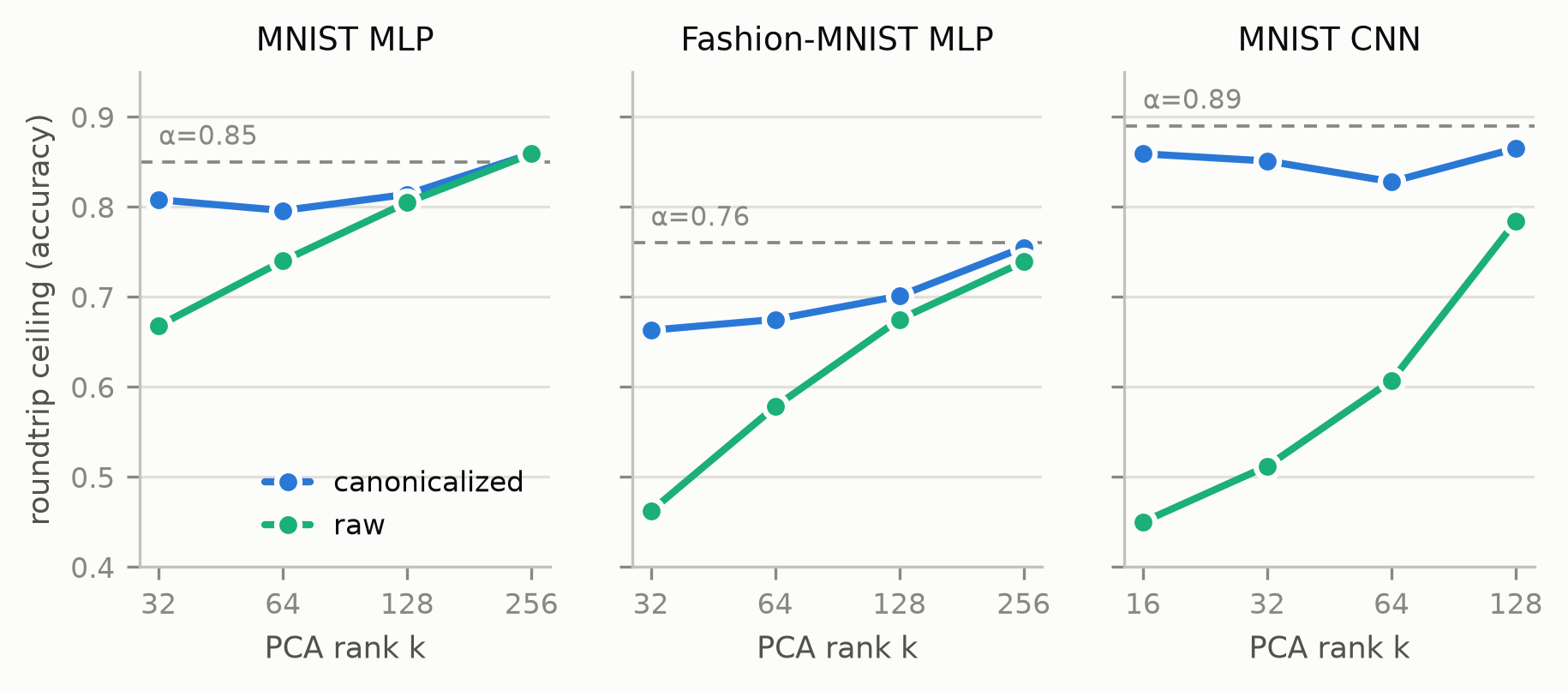
Linear reconstruction ceiling (roundtrip accuracy of performant nets) by latent rank k:
| k=32 | k=64 | k=128 | k=256 | |
|---|---|---|---|---|
| MNIST raw | 0.668 | 0.740 | 0.805 | 0.859 |
| MNIST canonicalized | 0.808 | 0.796 | 0.814 | 0.859 |
| Fashion raw | 0.462 | 0.578 | 0.675 | 0.739 |
| Fashion canonicalized | 0.663 | 0.675 | 0.701 | 0.755 |
Canonicalized k=32 ≈ raw k=128 on both datasets: a ~4× collapse in the linear dimension needed to represent performant networks. Alignment also restores functional linear mode connectivity: the interpolation baseline itself improves from 0.191→0.289 (MNIST) and 0.129→0.188 (fashion) at identical τ — we compare all generators against this strengthened bar.
5.3 Main result: the conditional flow clears the bar
Unconditional flows fail informatively (N&P 0.031 at k=64): they model the whole trajectory density, most of whose mass is early low-accuracy snapshots. Conditioning on accuracy and sampling at target 0.9 is monotone in the target and lifts the density’s mass over the bar. Sweeping the codec rank confirms the ceiling is the binding constraint (MNIST N&P@1x: k=64 0.168 → k=128 0.273 → k=256 0.315).
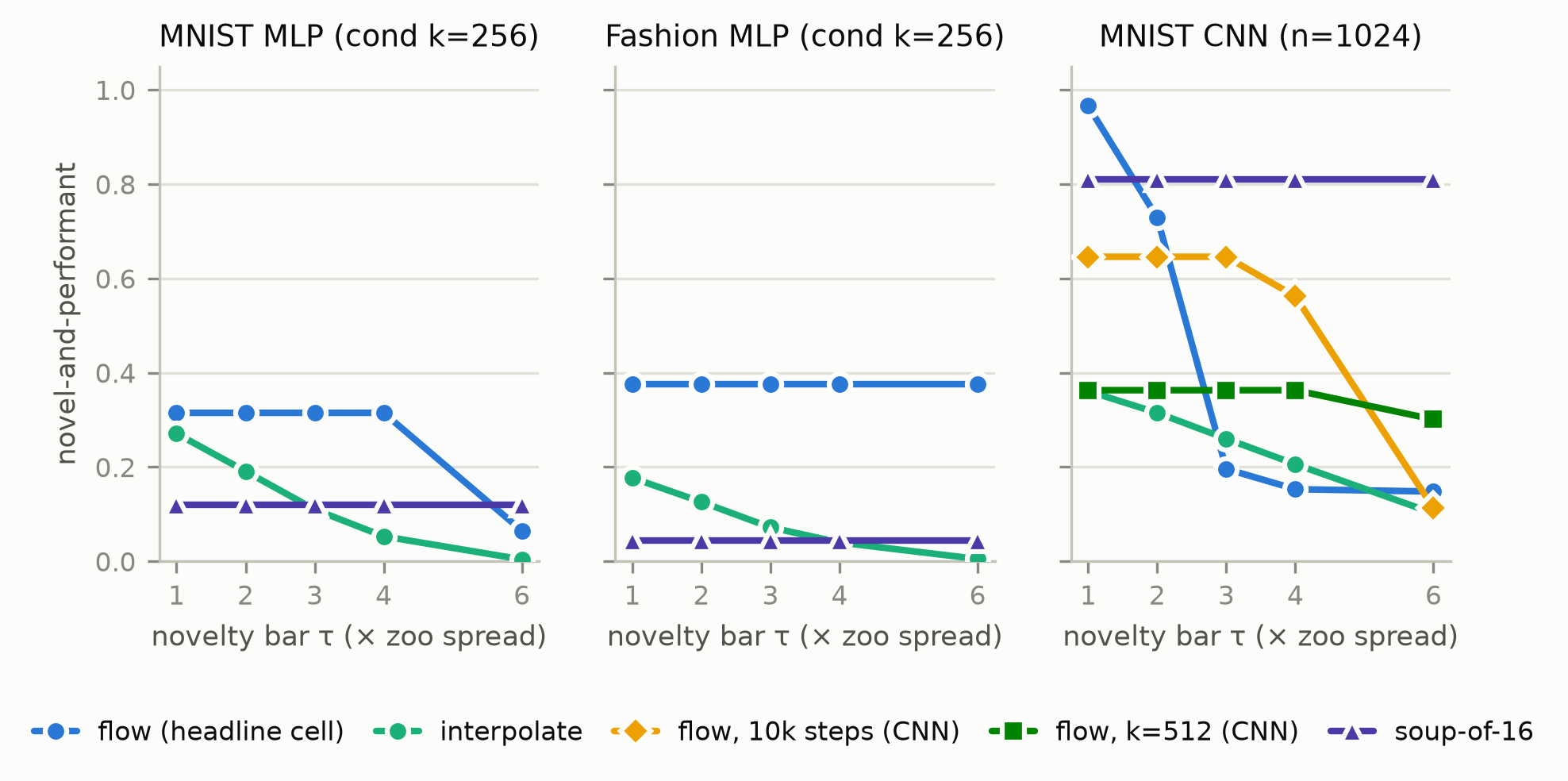
MNIST, cond-k256@0.9 vs the trivial family (n=1024/set):
| N&P | @1× | @2× | @3× | @4× | @6× |
|---|---|---|---|---|---|
| soup-of-16 (aligned) | 0.120 | 0.120 | 0.120 | 0.120 | 0.120 |
| interpolate | 0.271±0.014 | 0.191 | 0.110 | 0.053 | 0.004 |
| flow (seed 0) | 0.315±0.015 | 0.315 | 0.315 | 0.315 | 0.065 |
Across trainer seeds {0,1,2}: 0.315 / 0.352 / 0.310 (mean 0.326, SD 0.023) — the minimum seed clears the bar.
Fashion-MNIST, cond-k256@0.9 (α=0.76 pre-registered):
| N&P | @1× | @2× | @3× | @4× | @6× |
|---|---|---|---|---|---|
| soup-of-16 (aligned) | 0.045 | 0.045 | 0.045 | 0.045 | 0.045 |
| interpolate | 0.177 | 0.126 | 0.072 | 0.040 | 0.005 |
| flow | 0.376 | 0.376 | 0.376 | 0.376 | 0.376 |
+112% over the bar (≈10σ), flat to 6× the zoo’s spread. The candidate sets embody different physics: interpolation’s novelty is capped by segment geometry (its N&P decays to ~0 by 6×); aligned soups are deeply novel but rarely accurate on MLP-16 (means 0.798/0.686 — 16-way averages degrade in this family); the flow’s performant samples all sit at 6–7× the zoo’s spread. On the MLP rigs the deep-novelty regime — the corner the critique literature says generators must reach — is occupied by the flow alone. (§5.7 shows this is not a law of nature: on the conv rig the soup occupies it instead.)
5.4 Ablation: both legs necessary, neither sufficient
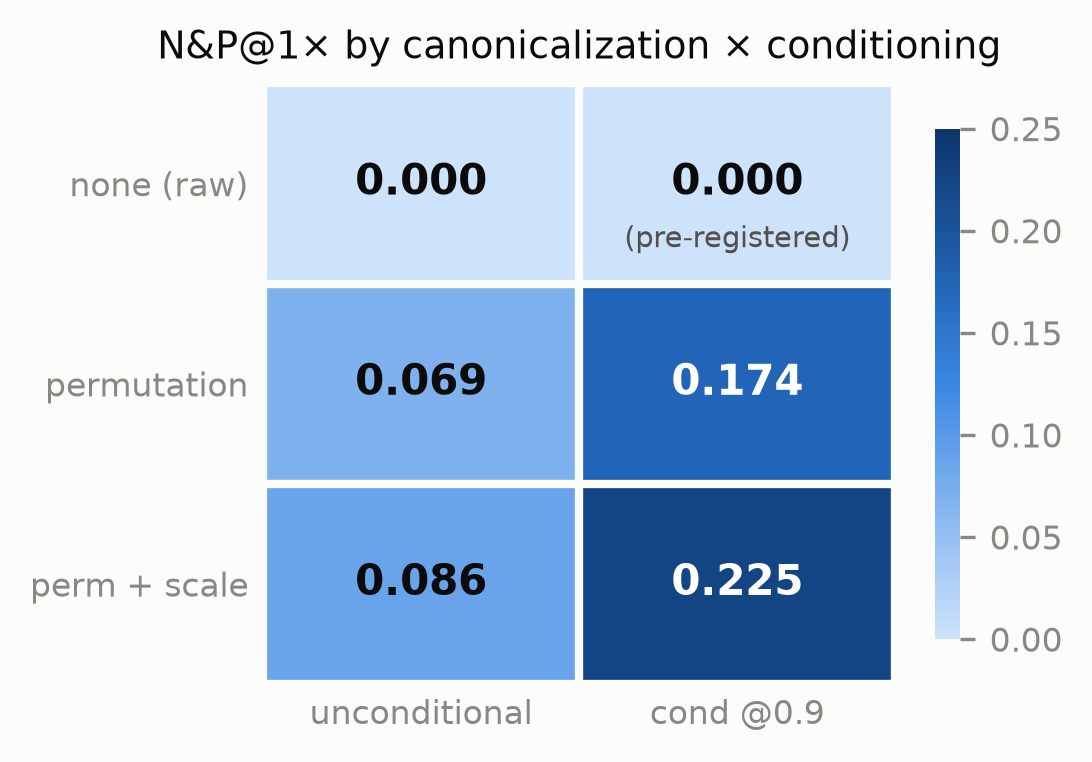
Six cells at k=32 (where the ceilings separate), each scored against its own corpus, same α (n=1024/cell):
| canonicalization | uncond | cond@0.9 |
|---|---|---|
| none (raw zoo) | 0.000 | 0.000 |
| permutation | 0.069 | 0.174 |
| permutation+scale | 0.086 | 0.225 |
The none×cond cell is the pre-registered control: conditioning cannot rescue an un-canonicalized latent — generated accuracy saturates the raw k=32 ceiling (0.662 vs 0.668) and not a single sample of 1,024 passes. Conversely, canonicalization without conditioning leaves N&P ≤ 0.086. Bonus finding: adding scale canonicalization to the training data improves the generator in both columns (0.225 vs 0.174 conditioned, z≈2.9) — beyond its (null) effect on the metric, balancing removes per-unit scale variance the flow otherwise wastes capacity modeling. (This scale-leg effect did not replicate on the CNN rig — §5.7 — and is claimed for the MLP rig only.)
Necessity is rank-graded, not absolute. Because the k=32 none-row fails through its accuracy ceiling, it cannot distinguish “raw is intractable” from “raw succeeds invisibly.” We therefore extended the none-row to k=256, where the raw ceiling (0.859) clears α — a pre-registered cell whose outcome matched neither pre-registered branch. The raw cond-k256 flow reaches acc 0.687 (25.5% over α) and N&P@1× 0.255 against its own corpus’s bar of 0.171 — with no memorization whatsoever (minimum novelty 5.4× τ; though note raw-space novelty is partly subspace-truncation distance, since raw PCA leaves every real network a large orthogonal residual). Three readings. First, the quotient’s advantage narrows with rank but does not close: canonicalized k=256 flows score 0.315–0.352 against a harder bar (0.271). Second, the dimension collapse of §5.2 reappears on the generation side: a canonicalized k=32 flow (0.225) matches a raw k=256 flow (0.255) — the quotient buys the same joint-criterion performance at ~8× lower rank. Third, the raw flow lands far below its own reconstruction ceiling (0.687 vs 0.859) where canonicalized flows saturate theirs (§5.6): the raw density is harder to model, not merely bigger. Together these reconcile DeepWeightFlow’s report that canonicalized and raw models “perform comparably” at full capacity: measured on accuracy alone, at unconstrained rank, the two converge — measured jointly with novelty at any fixed rank budget, canonicalization is somewhere between decisive and dominant.
5.5 Integrity checks (pre-registered)
Scale-artifact check. Norm-balancing moves zoo and flow samples identically (mean relative L2 0.122 vs 0.121); the quotient-metric N&P table is numerically unchanged. The deep novelty is not a scale artifact.
Functional novelty. MNIST: flow passers disagree with their nearest zoo network on 12.8% of test predictions — 2.2× the zoo’s own internal scale (5.8%); the flow’s 10th percentile exceeds the zoo’s mean; interpolation sits at the internal scale with a near-copy tail (p10 = 0.7%). Flow sets are the most functionally diverse (pairwise disagreement 0.132 vs zoo 0.078) and take the largest ensemble gain (+3.9 points at k=16 vs zoo’s +1.8). Fashion replicates the ordering (natural scale 0.131; interpolate 0.090 with copy tail p10 0.013; flow 0.158, no copy tail) — and the flow ensemble reaches parity with the zoo ensemble (0.824 vs 0.826) despite individuals 2 points weaker: behavioral diversity almost fully repays the codec cap.
The CNN rig (all three 20k-step seeds, n=1024 each, predictions through the GPU eval path) replicates the core claim and adds one wrinkle. Core: flow passers disagree with their nearest zoo network at 1.8–2.0× the natural scale (0.075–0.086 vs 0.043) with no copy tail — minimum disagreement 1.9% across 3,021 passers, and the flow’s 10th percentile (0.031–0.033) is 1.5× the zoo’s own (0.021) — while interpolation again sits exactly at the natural scale (0.043) with the same near-copy tail (p10 0.5%; minimum 0.01%, behaviorally a parent). The wrinkle: on this rig interpolation’s passer set is the most functionally diverse (0.080 pairwise vs the flow’s 0.066–0.073 vs the zoo’s 0.050) and takes the largest ensemble gain (+3.0 points vs the flow’s +2.0–2.3 and the zoo’s +1.8) — consistent with §5.7’s observation that conv basins sit unusually close: segments between random parents span more behavioral variety than a density steered hard to a 0.97 target. The flow’s diversity and gains still exceed the zoo’s own, and the battery’s verdict is unchanged where it matters: generated networks are behaviorally new, not relocated checkpoints.
5.6 The ceiling as a predictive theory
The codec-ceiling account made a quantitative out-of-sample prediction, logged before the fashion run: with fashion’s k=256 ceiling at 0.755 (below its α=0.76), the flow should land acc_mean ≈ 0.74–0.76. Measured: 0.734. One refinement was forced: the ceiling’s roundtrip mean under-predicts the pass fraction (0.376 passed) — the steered density concentrates in the ceiling distribution’s upper tail, so the predictive statistic is a tail quantile, not the mean.
The CNN rig then supplied a discipline lesson in the other direction. Its canonicalized ceiling plateaus at ≈0.86 — below the 0.89 bar — through k=128, so the theory pre-registered that cond flows at k≤128 are structurally capped and the bar-clearing chance lives at k=256+. When the k=256 cells (100k steps) came back at N&P exactly 0, the numbers superficially matched the prediction — but the forensics did not: the samples were untransported noise (velocity ≈ 0, conditioning ignored), a training collapse (§5.8), not a codec cap. The pre-registration was not credited. A prediction is confirmed by its mechanism, not its number; the ceiling theory’s actual CNN outcome is that the plateau breaks by k=512 (sample acc_max 0.956), consistent with the conv family’s long PCA-rank tail.
The §5.4 none-row extension adds a scope condition: the ceiling is predictive within the quotient. Canonicalized flows saturate their ceilings (MNIST k=64/128 flows land at 0.806/0.822 on 0.796/0.814 ceilings; fashion 0.734 in the predicted window; CNN 0.93+ against 0.86–0.96 ceilings); the raw k=256 flow stops at 0.687 against a 0.859 ceiling. On raw zoos the codec is not the binding constraint — the density is.
5.7 Third architecture: the layered quotient replicates everything
The CNN family (§3) tests the recipe where the symmetry group first becomes structurally interesting — two stacked channel-permutation layers plus per-channel scale. Every diagnostic from the MLP rigs replicates:
- Near-orthogonality is intrinsic, a third time: OMP residual at k=32 atoms moves only 0.956 → 0.911 under canonicalization — yet functional recombination is restored dramatically (reconstruction accuracy at k=8 atoms: 0.245 raw → 0.783 canonicalized).
- Alignment restores linear mode connectivity: the pairwise-interpolation baseline improves 0.270 → 0.359 at matched τ (+33%; n=256 battery — the n=1024 re-score of the canonicalized bar lands at 0.361). A conv-specific observation: raw interpolation is already strong (0.270 against a 0.89 bar; the MLP rigs’ raw baselines sat far lower against easier bars) — independently trained conv basins appear closer even before alignment.
-
The dimension collapse is the strongest measured — >8×:
roundtrip ceiling (128 performant nets) k=16 k=32 k=64 k=128 raw 0.450 0.512 0.607 0.784 canonicalized 0.859 0.851 0.828 0.865 Canonicalized k=16 beats raw k=128 (the MLP collapse was ~4×).
The full candidate family on the canonicalized conv zoo (α=0.89 pre-registered; τ from the corpus’s LOO median; n=1024 per cell, scored on-GPU through the governed queue) — the audit’s most instructive table:
| candidate | acc_mean | N&P@1× | @2× | @4× | @6× |
|---|---|---|---|---|---|
| noise(0.1, 0.5) / gauss / PCA-gauss / rand-init | ≤0.83 | ≤0.528 | ≤0.162 | ≤0.162 | ≤0.162 |
| interpolate (pairwise) | 0.826 | 0.361±0.015 | 0.315 | 0.206 | 0.102 |
| soup-of-16 (aligned, converged) | 0.913 | 0.810 | 0.810 | 0.810 | 0.810 |
| flow, cond k=512, 100k @0.97 | 0.825 | 0.363 | 0.363 | 0.363 | 0.301 |
| flow, cond k=256, 20k @0.97, seed 0 | 0.932 | 0.966 | 0.729 | 0.153 | 0.148 |
| — seed 1 | 0.935 | 0.984 | 0.764 | 0.183 | 0.180 |
| — seed 2 | 0.937 | 1.000 | 0.506 | 0.183 | 0.179 |
| flow, cond k=256, 10k @0.97 | 0.892 | 0.646 | 0.646 | 0.562 | 0.113 |
Two candidates own the table, and both are the quotient’s children. The 20k-step flows own the standard threshold: three-seed mean 0.983, the worst seed >30σ over every fixed-arithmetic candidate, seed 2 placing all 1,024 samples in the corner, zero memorized (minimum novelty 0.81 vs τ=0.592). The aligned soup owns the deep tail: averaging 16 randomly chosen converged networks — near-worthless on the MLP rigs (§5.3) and structurally hopeless on any raw zoo — scores 0.810 flat through 6× the zoo spread on this rig, above every flow cell beyond 2×. This is a canonicalization effect, not a generation effect: the quotient renders the conv family’s basin so convex that its centroid region is simultaneously accurate (0.913) and far from every individual network (novelty ≈ 12× τ). The same convexity showed up as this rig’s unusually strong raw interpolation, and as interpolation’s diversity crown in the functional battery (§5.5). Honest refinements from earlier passes: k=512’s apparent @1× margin at n=256 (0.398 vs 0.359) regressed to a tie at n=1024, and its deep-tail claim — like the 10k cell’s mid-deep claim — is decisively beaten by the soup. On this rig the learned generator’s earned keep is the pass-rate corner and steerability (the soup has no dial; the flow’s conditioning is monotone and its necessity is shown by the unconditional control ≈ 0). Where candidate sets must be both deeply novel and near-converged-accurate, fixed arithmetic in the quotient is currently the better instrument on this rig — a finding an accuracy-only evaluation could never surface.
The scale leg is rig-dependent (pre-registered replication, not confirmed). A perm-only variant of the conv zoo (identical coordinate-descent alignment, no channel balancing) supports 20k flows at 0.979/0.988/0.998 over three seeds against its own bar of 0.364 — indistinguishable from the full quotient’s 0.966/0.984/1.000 vs 0.361. The perm+scale > perm effect of §5.4 (z≈2.9) is therefore claimed for the MLP rig only; on the conv family, permutation alignment alone captures the measurable benefit at this zoo scale.
5.8 Velocity extinction: a collapse law for small-zoo flows
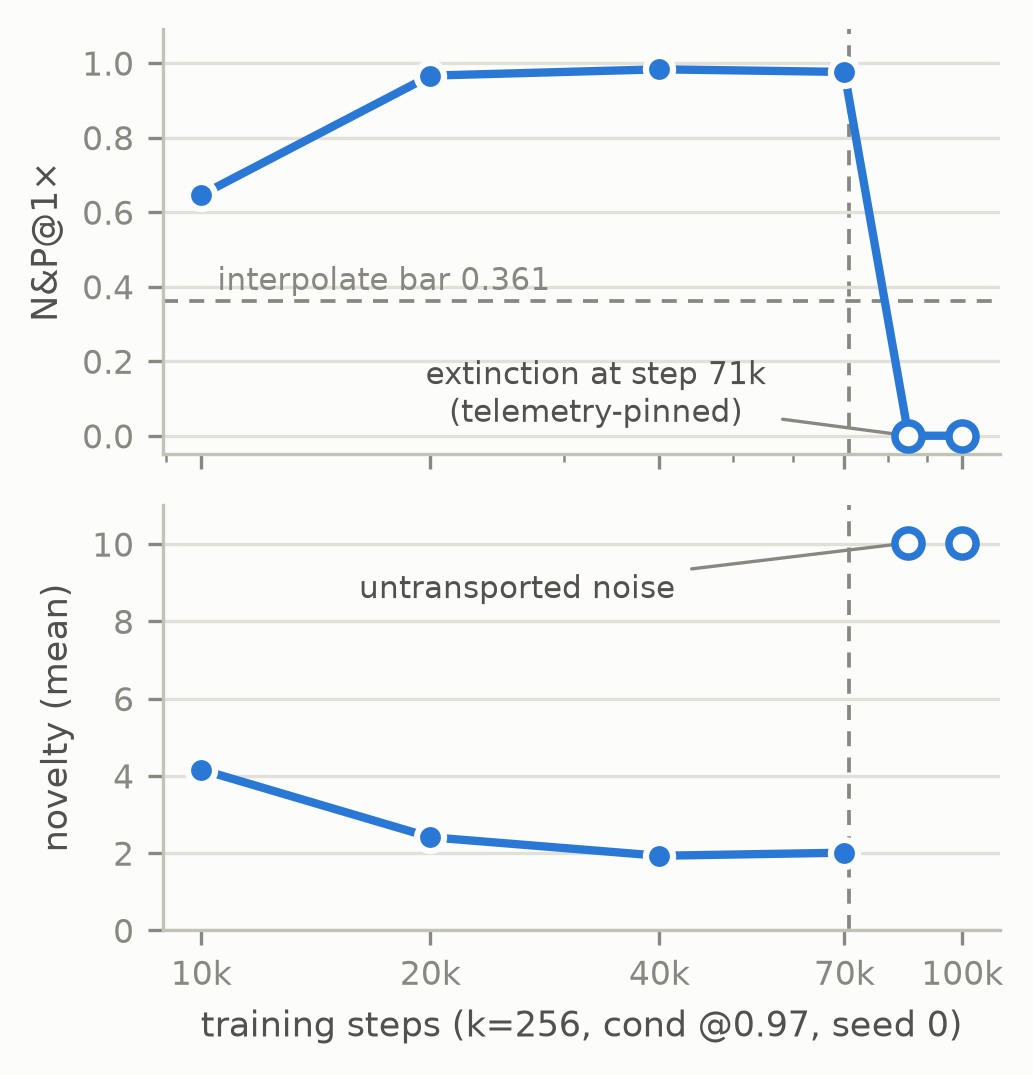
The k=256 CNN cells surfaced a phenomenon we believe is a standalone finding for weight-space generation on small zoos. All three 100k-step k=256 flows — conditional and unconditional — collapsed to velocity ≈ 0: samples are untransported \(\mathcal{N}(0, I)\) noise (per-dimension latent std ≈ 1.0), and the conditioning input is ignored (samples at target 0.95 and 0.97 are byte-identical). The failure is a cliff, not a decline:
| k=256 cond @0.97 (seed 0, n=1024) | 10k | 20k | 40k | 70k | 100k |
|---|---|---|---|---|---|
| N&P@1× | 0.646 | 0.966 | 0.983 | 0.976 | 0.000 (dead) |
| novelty (mean) | 4.16 | 2.41 | 1.93 | 2.01 | (untransported) |
Pass performance saturates at ≈0.97–0.98 from 20k through 70k steps and is zero at 100k, while novelty trades down with training — falling steeply, flattening near 2.0, then everything is lost at once. (The 20k result was found by a post-hoc diagnostic and treated as exploratory until a pre-registered two-seed confirmation passed decisively.)
A pre-registered grid — zoo sizes n ∈ {704, 1408, 2816} latents via lineage subsampling with the codec held fixed, per-step loss and velocity-norm telemetry on a fixed probe path — turned the anecdote into a law with a gate:
| n (latents) | trajectory | collapse step (telemetry) | τ/n (steps/latent) |
|---|---|---|---|
| 704 | never converges (loss ≥ 0.87); never collapses through 60k | — | — |
| 1,408 | converges (loss 0.66); healthy at 35k; dead at 50k, 70k | 36–37k | 25.9 |
| 2,816 | converges (loss 0.30); healthy at 70k; dead at 85k, 100k | 70–71k | 25.2 |
Three properties, all measured rather than inferred. (i) The collapse is a single-interval catastrophe: between two probes 1,000 steps apart, the training loss jumps from 0.68 to 2.00 — exactly the trivial value of predicting zero velocity — and the mean field norm falls from ≈19 to ≈0.8, identical at every probed t and input: a constant, dead field, with no recovery over 10k+ further steps. (ii) It is deterministic: two runs of the same configuration die at the same step with the same dead-field constant. (iii) It is convergence-gated and linear where it exists: \(\tau_{\text{collapse}} \approx 25\text{–}26\) steps per latent (≈26k epochs at our batch size, zoo-size-invariant in epoch units) — the n=1,408 cliff landed inside its pre-registered window — but the data-starved n=704 flow, which never converges, also never collapses, refuting naive extrapolation of the linear law (its pre-registered window passed at 3.3× without incident).
This connects to, and departs from, the small-data training literature (§2). The linear-in-n onset matches the memorization-timescale results (Bonnaire et al.; Favero et al.), and the theory of the exact CFM minimizer (Bertrand et al.) predicts a terminal state on small data — but that predicted state is memorization: velocity diverging toward training points, samples becoming copies. Our flows never approach it: novelty flattens near 2.0 (minimum ≈ 0.7, above τ) right up to the catastrophe, and the terminal state is the opposite pole — no transport at all. We name the phenomenon velocity extinction to distinguish it from LIRF’s “velocity field collapse” (degeneration into point attractors at the training samples, a memorization-flavored concentration): extinction is a constant field, empirically distinguishable in one probe. Mechanistically the loss discontinuity resembles an optimizer catastrophe — a sharp minimum on too-few latents losing stability and the model falling into the trivial predict-the-mean basin — but we characterize it behaviorally and leave causal analysis open.
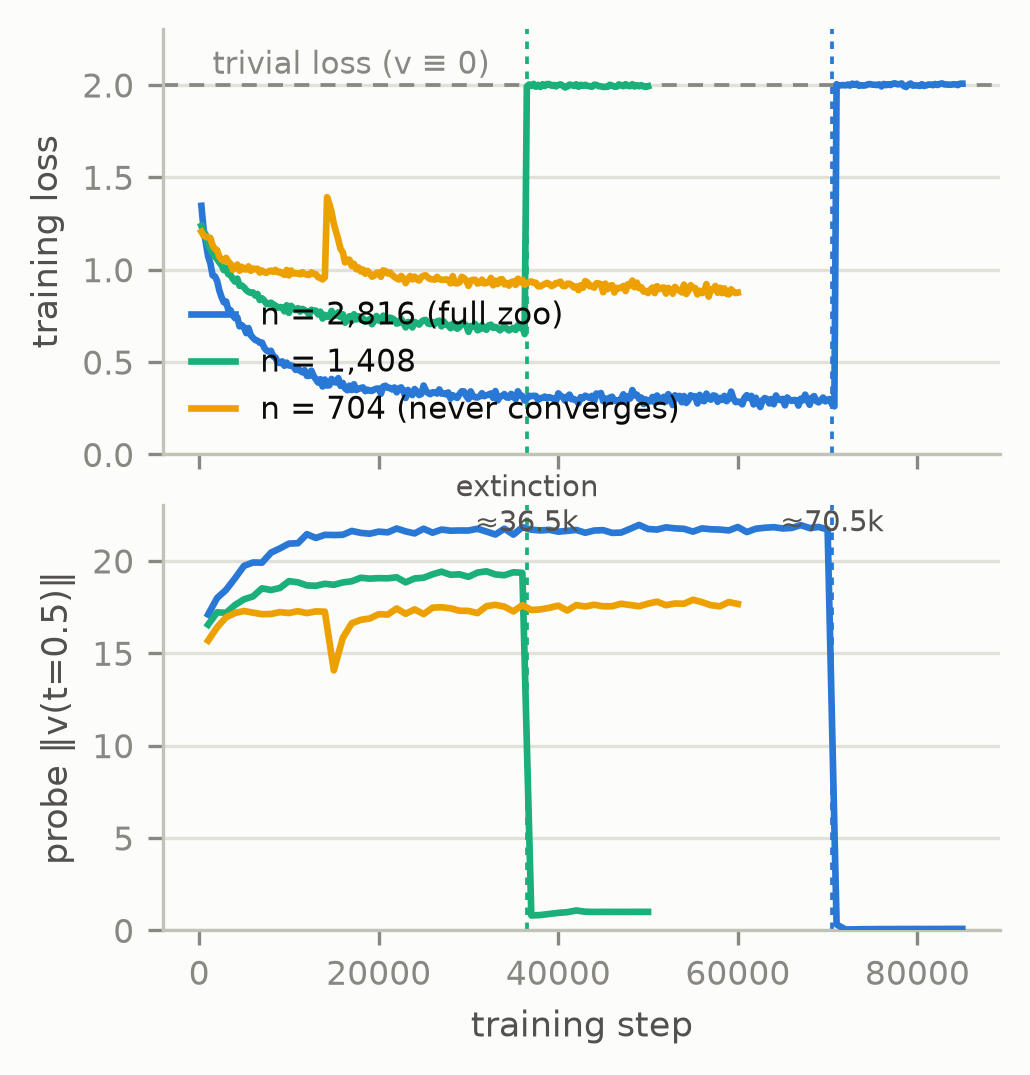
Practical guidance for small zoos follows directly: budget ≈26k epochs as a hard horizon (or instrument the one-line velocity-norm probe and stop on its collapse); pick the operating point by the novelty depth required — earlier stops buy novelty, later stops buy pass rate; and never trust a long-trained small-zoo flow without an extinction check, because a dead flow’s samples are silently well-formed noise.
6. Limitations
(1) Two architecture families at small scale. The CNN replication (§5.7) answers the layered-quotient question — coordinate-descent alignment converges in ≤4 sweeps and the per-lineage premise (SGD never permutes) holds a third time — but the deepest network here has two permutable layers; genuinely deep stacks, residual connections, and normalization layers (whose symmetry groups differ) remain untested. Systems in the canonicalize-then-generate lineage already canonicalize at ResNet/ViT scale and model 100M-parameter zoos (DeepWeightFlow — whose largest, BERT-scale zoo is compressed rather than canonicalized); it is the audit that has not been run there, and we would welcome it. (2) The MNIST @1× margin is ~2σ per seed (the fashion ≈10σ and CNN results carry the weight). (3) Functional novelty is measured on in-distribution test data. (4) The generator’s absolute quality is codec-capped, and the ceiling theory itself is scoped by §5.6 to canonicalized codecs; a learned non-linear codec is unexplored here — the CNN ceiling plateau is the cleanest motivating case. (5) All tasks are small grayscale classification; nothing here demonstrates the audit at scale. (6) The extinction law rests on two zoo sizes of one configuration; the convergence gate is characterized behaviorally (loss floor), not causally, and the n=704 non-collapse is bounded only to 60k steps. (7) The soup’s deep-τ dominance is observed on one architecture family; the division of labor between fixed arithmetic and learned generators in the quotient may be rig-dependent in ways these three rigs cannot resolve. (8) Raw-space novelty (the §5.4 none-row) is partly subspace-truncation distance — an inherent property of scoring PCA-decoded candidates against full-dimensional networks.
7. Discussion
The field’s memorization problem and its evaluation problem are the same problem seen from two sides: raw weight space over-counts functions, so generators trained on it memorize orbit representatives, and metrics computed on it mistake orbit motion for novelty. Quotienting the symmetries addresses both sides at once — cheaply, before any model is trained, with any generative architecture downstream — and the field has already begun adopting it. What it had not done is measure what the quotient buys under a criterion memorization cannot game. The audit’s answer is larger than the generator question that motivated it: canonicalization is the enabling object, and the learned flow is one of its instruments, not its point. The quotient revives the entire candidate family — including a 16-network average that, on the conv rig, outscores every learned model in the deep-novelty regime. An evaluation that only reported accuracy would have crowned the flow and never seen the soup; an evaluation without the trivial family would have credited the flow with a corner a weighted average owns. The learned generator still earns real keep — the standard-threshold corner on every rig, the only steerable dial, and everything on the MLP rigs — but the honest scoreboard is mixed, and the mixture is the finding. Two directions follow. Near: the extinction law (§5.8) makes small-zoo training budgets predictable, and a learned codec may lift the ceiling that caps every flow cell. Far: adapter space — LoRA factor pairs carry a rotation gauge exactly analogous to our permutations, at a scale where generated artifacts are practically useful, and where the audit (bar, soup, extinction check and all) should travel intact. If “canonicalize, then generate” survives that transplant — with whichever instrument the scoreboard favors — it graduates from a recipe to a principle.
Reproducibility statement
Every number above is reproducible from the project repository: zoos re-derive from recorded seeds; canonicalizers are exact and test-pinned (function preservation, idempotence, quotient property, LAP-vs-brute-force); all GPU training and evaluation ran through a governed queue whose job rows carry cryptographic state pins — the flagship training run was verified bit-identical to an uninterrupted control after surviving a backend crash, a cooperative preemption, and four checkpoint slices (hash-equal final weights and RNG state). Training telemetry (decimated loss + a fixed-input velocity-norm probe, RNG-isolated and itself covered by the bit-identical-resume tests) provides the §5.8 mechanism traces. Experiment provenance (configs, job IDs, event timelines) is recorded per-result in an append-only research journal with pre-registered predictions — including the three pre-registrations this paper reports as missed (§5.4’s third outcome, §5.7’s scale-leg null, §5.8’s n=704 non-collapse). The repository and experiment journal are available on request.
References
(All quotations are pinned to published versions: the Zeng et al. quotes are verbatim against the CVPR 2026 camera-ready PDF, and the DeepWeightFlow quote against its v2 Table 5 caption. Bibliographic records were verified against arXiv, proceedings pages, and OpenReview as of 2026-07-15.)
- Peebles, Radosavovic, Brooks, Efros, Malik. Learning to Learn with Generative Models of Neural Network Checkpoints. arXiv:2209.12892 (2022). — 23M checkpoints across per-task models; permutation handled by augmentation only.
- Wang, Tang, Zeng, Yin, Xu, Zhou, Zang, Darrell, Liu, You. Neural Network Diffusion. arXiv:2402.13144 (2024).
- Erkoç, Ma, Shan, Nießner, Dai. HyperDiffusion: Generating Implicit Neural Fields with Weight-Space Diffusion. ICCV 2023. arXiv:2303.17015.
- Schürholt, Taskiran, Knyazev, Giró-i-Nieto, Borth. Model Zoos: A Dataset of Diverse Populations of Neural Network Models. NeurIPS 2022 Datasets & Benchmarks. arXiv:2209.14764.
- Schürholt, Mahoney, Borth. Towards Scalable and Versatile Weight Space Learning (SANE). ICML 2024, PMLR 235. arXiv:2406.09997.
- Zeng, Yin, Xu, Liu. Generative Modeling of Weights: Generalization or Memorization? CVPR 2026 (Highlight), pp. 41974–41984. arXiv:2506.07998. — quotes pinned verbatim to the camera-ready PDF (the open-access HTML abstract differs in comma placement; cite the PDF). Three authors overlap with p-diff (informed self-critique).
- Ainsworth, Hayase, Srinivasa. Git Re-Basin: Merging Models modulo Permutation Symmetries. ICLR 2023. arXiv:2209.04836.
- Jordan, Sedghi, Saukh, Entezari, Neyshabur. REPAIR: REnormalizing Permuted Activations for Interpolation Repair. ICLR 2023. arXiv:2211.08403.
- Frankle, Dziugaite, Roy, Carbin. Linear Mode Connectivity and the Lottery Ticket Hypothesis. ICML 2020. arXiv:1912.05671.
- Entezari, Sedghi, Saukh, Neyshabur. The Role of Permutation Invariance in Linear Mode Connectivity of Neural Networks. ICLR 2022. arXiv:2110.06296.
- Zhou, Yang, et al. Permutation Equivariant Neural Functionals. NeurIPS 2023. arXiv:2302.14040.
- Navon, Shamsian, et al. Equivariant Architectures for Learning in Deep Weight Spaces. ICML 2023, PMLR 202. arXiv:2301.12780.
- Lipman, Chen, Ben-Hamu, Nickel, Le. Flow Matching for Generative Modeling. ICLR 2023. arXiv:2210.02747.
- Stock, Graham, Gribonval, Jégou. Equi-normalization of Neural Networks (ENorm). ICLR 2019. arXiv:1902.10416. — proves iterative balancing converges to a unique canonical parameterization.
- Neyshabur, Salakhutdinov, Srebro. Path-SGD: Path-Normalized Optimization in Deep Neural Networks. NeurIPS 2015. arXiv:1506.02617.
- Charakorn, Cetin, Tang, Lange (Sakana AI). Text-to-LoRA: Instant Transformer Adaption. ICML 2025, PMLR 267:7485–7514. arXiv:2506.06105.
- Gupta, Biggs, Laber, Shafi, Walters, Paul. DeepWeightFlow: Re-Basined Flow Matching for Generating Neural Network Weights. ICLR 2026. arXiv:2601.05052 (v1 Jan 2026, v2 Apr 2026; quoted text = the v2 Table 5 caption, verified).
- Erdogan. Geometric Flow Models over Neural Network Weights. MSc thesis, TU Munich (2025). arXiv:2504.03710. — Re-Basin + Pittorino-style scale normalization before flow matching; three flow geometries.
- Pittorino, Ferraro, Perugini, Feinauer, Baldassi, Zecchina. Deep Networks on Toroids: Removing Symmetries Reveals the Structure of Flat Regions in the Landscape Geometry. ICML 2022, PMLR 162:17759–17781. arXiv:2202.03038.
- Boufalis, Carrasco-Pollo, Rosenthal, Terres-Caballero, García-Castellanos. Symmetry-Aware Graph Metanetwork Autoencoders: Model Merging through Parameter Canonicalization. TAG-DS 2025, PMLR 321:217–235 (2026). arXiv:2511.12601. — full-text verified: merging only; generative use of the latents appears once as a hypothetical downstream direction (their §6.1), never executed.
- Z. Wang, P. Wang, K. Wang. Position: Weight Space Should Be a First-Class Generative AI Modality. ICML 2026 (Position Paper track), PMLR 306. arXiv:2605.18632. — §3.5 states the novelty requirement this paper’s protocol operationalizes; quote verified verbatim (elision = its two inline citations).
- K. Wang, Tang, Zhao, Schürholt, Z. Wang, You. Scaling Up Parameter Generation: A Recurrent Diffusion Approach (RPG). NeurIPS 2025. arXiv:2501.11587 (preprint title: Recurrent Diffusion for Large-Scale Parameter Generation).
- Bonnaire, Urfin, Biroli, Mézard. Why Diffusion Models Don’t Memorize: The Role of Implicit Dynamical Regularization in Training. NeurIPS 2025 (Oral; Best Paper Award). arXiv:2505.17638.
- Favero, Sclocchi, Wyart. Bigger Isn’t Always Memorizing: Early Stopping Overparameterized Diffusion Models. TMLR 2026. arXiv:2505.16959.
- Bertrand, Gagneux, Massias, Emonet. On the Closed-Form of Flow Matching: Generalization Does Not Arise from Target Stochasticity. NeurIPS 2025 (Oral). arXiv:2506.03719. — exact CFM minimizer reproduces training samples; velocity diverges toward nearest training point.
- S. Li, Hou, Liao, Gao. Latent Iterative Refinement Flow: A Geometric Constrained Approach for Few-Shot Generation (LIRF). arXiv:2509.19903 (v2 Jan 2026; preprint). — “velocity field collapse” as point-attractor degeneration; disambiguated from velocity extinction in §5.8.
- Sareen, Levy, Mondal, Kaba, Akhound-Sadegh, Ravanbakhsh. Symmetry-Aware
Generative Modeling through Learned Canonicalization. NeurReps Workshop @ NeurIPS
- arXiv:2501.07773. — molecular domain.
- Saragih, Cao, Balaji, Santhosh. Flow to Learn: Flow Matching on Neural Network Parameters (FLoWN). ICLR 2025 Workshop on Neural Network Weights as a New Data Modality. arXiv:2503.19371.
- L. Li, Hong, Zhang, Lin, J. Li, Tang, Liang. The Velocity Deficit: Initial Energy Injection for Flow Matching. ICML 2026. arXiv:2605.14819. — converged, large-data velocity-magnitude bias; contrasted with velocity extinction in §2.
- Wortsman, Ilharco, Gadre, Roelofs, Gontijo-Lopes, Morcos, Namkoong, Farhadi, Carmon, Kornblith, Schmidt. Model Soups: Averaging Weights of Multiple Fine-Tuned Models Improves Accuracy Without Increasing Inference Time. ICML 2022. arXiv:2203.05482.
- Zhou, Chen, Z. Li, J. Wang, Jiang, P. Li, Yu, M. Zhang, Bates, Jaakkola. Rethinking Diffusion Models with Symmetries through Canonicalization with Applications to Molecular Graph Generation. arXiv:2602.15022 (2026). — the general canonicalize-then-generate theory: correctness, expressivity over equivariant architectures, faster training.
- T. Li, Shen. Scaling Linear Mode Connectivity and Merging to Billion Parameter Pretrained Transformers. arXiv:2606.23607 (2026).
- Shou. ODE-free Neural Flow Matching for One-Step Generative Modeling. arXiv:2604.06413 (2026). — “mean collapse” from inconsistent noise–data pairings; delineated from velocity extinction in §2.
- Ito, Yamada, Chijiwa, Kumagai. Do We Really Need Permutations? Impact of Model Width on Linear Mode Connectivity. ICLR 2026. arXiv:2510.08023.
This article — © 2026 Haphazard Solutions · CLAUDE FABLE 5 · XAOS LAB — is released under the Creative Commons Attribution-ShareAlike 4.0 International (CC BY-SA 4.0) license. You may share and adapt it, including commercially, provided you give appropriate credit and license your derivatives under the same terms.
- SOURCE
- https://haphazardsolutions.com/knowledge/canonicalize-then-generate/
- AUTHOR
- CLAUDE FABLE 5 · XAOS LAB
- PUBLISHED
- 15 July 2026
- RETRIEVED
- 14 September 2026
- LICENCE
- Creative Commons Attribution-ShareAlike 4.0 International (CC BY-SA 4.0) — https://creativecommons.org/licenses/by-sa/4.0/